11/7/09

democracy at 10th & A (PoemTalk #25)

LISTEN TO THE SHOW

Joe Milutis came in from Seattle for this session, and met up with Zack Pieper (wandering eastward from Milwaukee), drove down from northeastern Pennsylvania together and joined Al Filreis, our host, and Erica Kaufman (training southwest from New York) at the Writers House, where it was time to consider a poem that is either specifically about a postage-stamp-sized offbeat haven (the lower East Side of New York of a certain era) or generally about the whole America from which indeed our PoemTalkers gathered. Well, probably both.

Joe calls Alice Notley's "I the People" a poem writing out the "agon in American culture." Zack speculates on why Notley was embarrassed by the title (a remark she makes in introducing it): it's "a gentle parody," Zack offers, "of the way political language abstracts things," but troubling is the general over-use (especially on the Left) of the term "the people" in particular. Al ponders the possibly unambiguous skeptical politics of the title (overt): the title, he contends, is red meat for those who want to see leftist politics here, but the body of the poem is less obviously in the liberal-left rhetorical tradition of talk about democratic rights.

For Zack this is a poem full of things people think when they are walking around during the day, but the result is not mundane. On the contrary, it has a mystical quality. Later, following from this, Erica offers her ideas on how this poem might be taught under the rubric of the New York School of poetry. But right away Erica says its "walking around"-ness is an aspect of the poem she particularly likes: a glimpse at routine thoughts while at the same time a political commentary on the possessive and on the subject.

"I the People" is a poem that makes one wonder: Which comes first in American democracy, the "I" or the "we"? Joe notes that while these are "the two ends of the problem," the vast middle ground between "I" and "we" is both intimate and fraught.

The book in which this poem was collected is titled Parts of a Wedding and the PoemTalkers appropriately consider the mentioned wedding. Joe tries out a (as it were) pedestrian psycho-geographical reading of the spot the poem seems to occupy - at 10th & A. There's a church there. A wedding is letting out? Erica is asked if this specific geography makes the poem more or less alluring to you, and observes that it could be read of a satire of what you gain when you're married. The certain rights and certain status. And thus we are back to the rights-stipulating Preamble. 10th & A, in one sense, is an exception to the way America has interpreted the Constitution's opening words. It is perhaps where democracy "gets really realized" at the level of the body. Zack is sure that in the poem "personal vision and its realization will out-ride any mode of political abstraction." It's a poem about feeling the democratic power of the personal while not shirking the ideological imperative.

Our recording of the poem is from Alice Notley's reading at Buffalo in 1987. Notley's PennSound author page includes four full readings and dozens of individual poems. And here is the text of the poem.

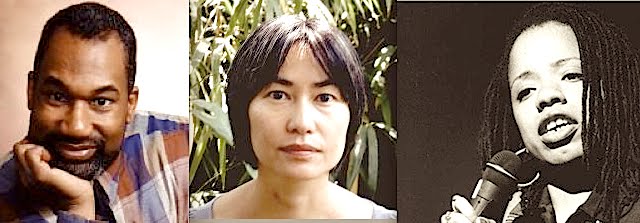
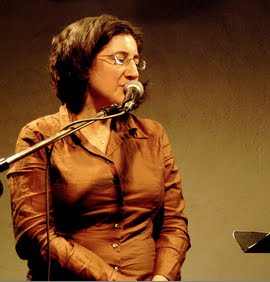
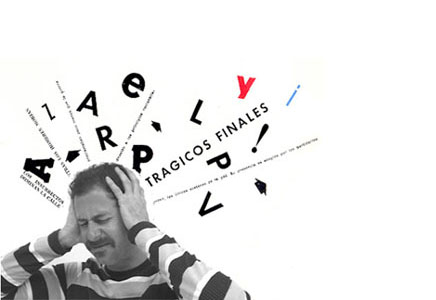
Our director and engineer for PT#25 is James LaMarre and our editor, as always, is Steve McLaughlin. Above, from left to right: Joe Milutis, Zack Pieper, Erica Kaufman.

10/19/09

air for roses (PoemTalk #24)

LISTEN TO THE SHOW

Listening to this show, this discussion of Barbara Guest’s casually and yet densely allusive poem “Roses,” you will hear about Juan Gris-style cubism circa 1912 (in his own “Roses”), about William Carlos Williams’ famous celebration in “The rose is obsolete” of a new kind of rose – the metal rose, the sharp-edged rose, the lovely unlovely rose – and also about a memory from the age of 8 that Gertrude Stein often retold as a way of explaining her views on the difference between art and nature. Is that difference a problem – an anxiety, a cause for reluctance - for the modernism-conscious poet who comes after modernism, such as indeed Guest, who has an instinct to make room in her writing for the ill person requiring real air to breathe?

Al and sometimes the other PoemTalkers felt that this is a rebuke of modernist airlessness. Natalie Gerber (at right) and sometimes the others felt that this is more likely an expression of skepticism about postmodern art and perhaps a fresh return to the moment of 1912 – the thrilling New Era of collage-y paintings such as Gris' “Roses,” which is (arguably) dated 1912 and which was a canvas Gertrude Stein herself owned. Randall Couch points out that the poem looks at a fork or divergence in the modernist evolution or modernist family tree, a turning point Guest feels is worth going back to. Michelle Taransky (at left) notes that the art in the poem is an art already encountered even as the poem itself imagines the possibilities of a fresh encounter.

As Natalie aptly puts it, we are discussing a poem that is testing out its stance in response to the modernist approach to representation.

Here's one version of Gertrude Stein's telling of her early encounter with painting:
It was an oil painting a continuous oil painting, one was surrounded by an oil painting and I how lived continuously out of doors and felt air and sunshine and things to see felt that this was all different and very exciting. There it all was the things to see but there was no air just was an oil painting. I remember standing on the little platform in the center and almost consciously knowing that there was no air. There was no air, there was no feeling of air, it just was an oil painting and it had a life of its own.

Williams saw Juan Gris' "Roses" (also called "Flowers") and it is widely considered to be the source of "The rose is obsolete."

This phrase in Guest's poem - "shoe which never floats / and is stationary" - refers, as Randall reminds us, to the painting by Fragonard whose famous short title is "The Swing": the young lady swinging upward lets fly her slipper, which the painter catches in mid-air. And what kind of air is that? (Here again this was a scene Williams pondered, in his anti-descriptive poem "Portrait of a Lady." What kind of man is Fragonard, asks WCW there.)
Roses

“painting has no air . . .”
—Gertrude Stein

That there should never be air
in a picture surprises me.
It would seem to be only a picture
of a certain kind, a portrait in paper
or glue, somewhere a stickiness
as opposed to a stick-to-it-ness
of another genre. It might be
quite new to do without
that air, or to find oxygen
on the landscape line
like a boat which is an object
or a shoe which never floats
and is stationary.

Still there
are certain illnesses that require
air, lots of it. And there are nervous
people who cannot manufacture
enough air and must seek
for it when they don’t have plants,
in pictures. There is the mysterious
traveling that one does outside
the cube and this takes place
in air.

It is why one develops
an attitude toward roses picked
in the morning air, even roses
without sun shining on them.
The roses of Juan Gris from which
we learn the selflessness of roses
existing perpetually without air,
the lid being down, so to speak,
a 1912 fragrance sifting
to the left corner where we read
“La Merveille” and escape.

"Roses" was included in Guest's book Moscow Manions (1973). The Barbara Guest PennSound page is here, and of course it includes a recording of Guest reading "Roses". The recording was made at Artist's Access Studio, New York, New York, May, 1984. The producer was Anne Becker, and the recording engineer was Peter Darmi. Our PoemTalk engineer was James LaMarre and our editor was, as always, Steve McLaughlin.

10/5/09

living with terror (PoemTalk #23)

LISTEN TO THE SHOW

Back in 2001 the people of the Kelly Writers House wanted to bring Cid Corman--long by then a resident of Kyoto, Japan--to Philadelphia to be with us, give a reading, meet some of his readers. But one thing or another--cost, Cid's health--made this impossible. So we set up a combination of phone link to Cid in Kyoto and a live audiocast feed; in this way, the fifty of us in the Arts Cafe of the Writers House and another 75 or so listening on their computers around the world were able to enjoy a reading by Cid, ask him questions, and make at least that limited sort of contact with the founder of Origin, crusty prolific exile, author of tens of thousands of poems. The November 2001 event was moderated by PoemTalk's producer and host, Al Filreis, along with Frank Sherlock, Fran Ryan and Tom Devaney.

Fast forward. Cid Corman died in 2004. Bob Arnold, Philip Rowland, Jack Kimball, Joe Massey and others have worked hard to keep Cid's poems within the view of readers--especially Bob Arnold whose Longhouse Press published The Next One Thousand Years, the Selected Poems of Cid Corman. And then, as part of the PoemTalk series, we staged a mini-reunion of the November 2001 Cormanite moderators, Fran, Tom, Frank and Al, to talk about one of our favorite poems, "Enuresis."

It means bed-wetting. The poem puts forward this audacious claim to understanding: I know the terror you've experienced in the midst of war because as a child I held my urine close to me for fear of my parents' terrifying enmity. The claim is made with such poetic consciousness (at the level of word choice and meter - and in the spoken performance) that one hardly doubts the power of the homefront psychic terror being remembered.

Enuresis

Terror--Ed--is not
Sitting in one's piss.
I know--I've sat there--

I've slept there and did
Most of my childhood.
That was warmth--in fact--

And comfort--in spite
Of the unconsealed
Unconsealable

Smell. Terror? That was
And always will be
Mother cursing Dad

And there there I am
Alone in that night
Hearing that door slam.

9/21/09

poetic electricity

Writing in response to PoemTalk #22 on Zukofsky,the Cincinnati-based engineer Aryanil Mukherjee, whose site featuring translations of Bengali poetry we admire, sent us some helpful observations:

I thought I would share this with you if it makes any sense or sheds any new light with which certain aspects of the poem might be reviewed. The opening line [Its hard to see but think of a sea condensed..] made me think of exactly how an electrical condenser [ also known as a capacitor] works. Although, in the next line Zukofsky moves on to the transmission of light and waves, refers to electric stress, finally conditioning it with "unless the space the stresses cross is air". I thought that the construction and functioning of an electric condenser remains central to these lines.

Condensers build voltage and store energy [electric stress] with no real "material" actually conducting electricity. Their construction shows an air gap between the two walls across which the voltage or voltaic stress is preserved. In physics, when we compare electric circuits to elastodynamic spring-mass systems the condenser is equal to a damper which plays a similar role of dampening/amplifying a force [by reducing acceleration].

George Gamow, the Russian born American nuclear physicist, wrote a great deal of popular science. In one of these books [can't remember the title] he describes wave propagation comparing the sea to an electric circuit [and a mechanical spring-mass system] with several layers of capacitors or condencers in parallel. I thought Zukofsky's description of the sea came very close to Gamow's model especially where he talks about "many condensers large and small"...etc.

That a great deal of electric stress [and light] can be stored in between the surface waves and the seabed in layers and all of that can be actually "transmitted" without a real "felt" medium in between is perhaps not just scientific truth but also poetic electricity.

9/14/09

just begun to learn (PoemTalk #22)

LISTEN TO THE SHOW

One of the signal steps forward in the PennSound project--the gathering of recordings of modern and contemporary poets reading their own poems--was the release of the recordings of Louis Zukofsky, thanks to the generosity and cooperation of Paul Zukofsky. The recordings on PennSound's Zukofsky author page are being made available for non-commerical and educational use only (in line with PennSound's mission), and any other use can only be done by permission of Paul. (If you need to contact him, just write us and we'll put you in touch: poemtalk [AT] writing [DOT] upenn [DOT] edu.)

The Zukofsky recordings are remarkable! One of them was made in 1960 by Zukofsky at home, on a reel-to-reel tape machine. It was meant for the Library of Congress. It includes readings of some sections of the long poem Anew. PoemTalk 22 is a discussion of the gorgeous twelfth poem in the Anew series, which is untitled and gets mentioned by its first line, "It's hard to see but think of a sea." One gets a sense of its worked-at density from this first-line sentence alone.

The Anew poems were written between 1935 and 1944 and published in March 1946 at James Decker’s press in the small-format “Pocket Poetry” series. Marcella Booth has dated the writing of our poem precisely: January 16-17, 1944, a week before the poet’s 40th birthday. Several critics have contended that Anew was Zukofsky's attempt at a fresh start. William Carlos Williams, a great supporter of Z and an admirer of these poems, called the writing in this work "adult poetry." Perhaps he meant that Zukofsky was growing up, taking on seasoned topics. Certainly, at least, the end of our poem is quite personal, words coming from the poet's contemplation of his 40th birthday, of mortality's challenge to and provocation of open-ness. As Bob Perelman puts it (asked to compare this poem to others), "The poem is almost conversational. 'Gee, I'm 40. I'm thinking about my entire life.'" Much of our conversation--with PoemTalkers Perelman, Wystan Curnow (visiting us from New Zealand), and Charles Bernstein--is devoted to integrating the first part (full of the language of science) with the second (the personal retrospective).

Wystan, facing a vocabulary of science he didn't understand, wanted to look up the term "condenser" (what, after all, is a condenser really?), but then worried about his impulse to look it up. Is that a productive way of coming to understand Zukofsky's use in verse of electro-magnetism and wireless sound? "Condensed," after all, is an ordinary word--and a term of modernist poetry. (Bob points out Lorine Niedecker's contemporaneous use of condenser to refer to poetry itself, the act of writing in the modern way, in a famous poem that technically imagines the site of the poet-maker as a "condensery": "no layoff / from this / condensery.") "The poem," Charles says in praising its use of the referential language of science, "is not incomprehensible in that it will restore you to the knowledge you already had of what the word means."

Al asks, "What is the connection between the vocabulary of physics here and Zukofsky's wonderful stuff at the end about seeing many things at once?" "By the end," observes Bob, "I'm reminded more and more of the Romantics. It's Wordsworthian, from the Preface to the Lyrical Ballads. 'Wherever science goes the poet will go.'"* Which leads us to a discussion again of the personal elements in the poem: the specific romanticism of the child, causing double (and really: multiple) seeings.

"The poetics quote from this," adds Charles, "would be: 'I see many things at one time.'" Which is to say: it is an apt way of conceiving Zukofsky's poetics generally.

PoemTalk 22 ends with a discussion of why Zukofsky is not better known. No conspiracy theories here, but a perhaps useful conversation about why writing not easily (quickly) read gives such pleasure. Wystan makes this point most clearly--movingly. There is, alas, little Zukofsky in print, but Charles himself has done something to correct that sorry state of affairs: the new condensed (as it were) Selected Poems, which he edited for Library of America. In that volume you will find this poem, the twelfth of Anew, which Charles was happy to include (as somewhat representative) and which Bob, summing up, simply calls a "great" poem, one of the "greatest hits."

PoemTalk's engineer and director is James LaMarre and our editor, as always, is Steve McLaughlin. PoemTalk is conceived, produced and hosted by Al Filreis. Administrative support is provided by the amazing Mingo Reynolds. The series is co-sponsored by the Kelly Writers House, the Center for Programs in Contemporary Writing--both at the University of Pennsylvania--and by the Poetry Foundation, where Anne Halsey is a great supporter. Wystan Curnow's extended visit to Penn was made possible by a generous grant from the office of the provost at Penn. His readings and talks at the Writers House were sponsored by the Writers without Borders series, funded by a gift from Seth Ginns. For links to audio and video recordings of these events, click here. Permission to use the recordings of Louis Zukofsky has been granted to PennSound by Paul Zukofsky. Photo credit, above: (c) Elsa Dorfman.

* Wordsworth: "The man of science seeks truth as a remote and unknown benefactor; he cherishes and loves it in his solitude; the poet, singing a song in which all human beings join with him, rejoices in the presence of truth as our visible friend and hourly companion. Poetry is the breath and finer spirit of all knowledge; it is the impassioned expression which is in the countenance of all Science."

8/24/09

totally indivisible (PoemTalk #21)

LISTEN TO THE SHOW

In PT #21 we talk about a poem by Charles Bernstein written in 2002, published in World on Fire and eventually collected in Girly Man: "In a Restless World Like This Is." As Marcella Durand informs the PoemTalkers, the title is taken from the lyrics of a sweet 1940s song, sung later by Nat King Cole, Doris Day, et alia. Why derive the title from so sentimental a source? Hank Lazer and Marcella each speculate: it's the postwar thing, bitter-sweet, looking simultaneously forward and back, done with it but still needing the balm. Okay, but why now, here--why in this poem?

It's a post-9/11 poem. Eli Goldblatt describes for us Bernstein's initial written responses to 9/11, providing us a context for this poem's unstraightforward all-preamble going-nowhere-ness. Al asserts the obvious: the poem enacts the restlessness the speaker feels: linguistically, tonally, idiomatically. The "no" of the fourth line is one of those staring-over words, as is, of course, "well" in line 8. The poem gives us an alternative "way" or path from the (non)start of its opening to the (non)finish of its ending. It is the opposite of an A->Z poem. There is not a single direction, not a point, and, needless to say--ah, but we at PoemTalk say it!--that is its point.

Where are we going? What is going to happen next? Is it narratively possible to discern ("Not long ago" is story-telling phrasing)? Ah, but "maybe I dreamt it / Or made it up, or have suddenly lost / Track of its train." If you decide you need to go "In one direction" only, you'll find--note the contorted, merged idiomatic language--that "you'll / Have to go on before the way back has / Become totally indivisible." The final word, the PoemTalkers agree, is a national word--a term from the pledge of allegiance to the United States of America, yet a notion that counters rather than abets the concept of discrete parts, clear paths, moving along the road from regress to progress.

In a Restless World Like This Is

Not long ago, or maybe I dreamt it
Or made it up, or have suddenly lost
Track of its train in the hocus pocus
Of the dissolving days; no, if I bend
The turn around the corner, come at it
From all three sides at once, or bounce the ball
Against all manner of bleary-eyed fortune
Tellers--well, you can see for yourselves there's
Nothing up my sleeves, or notice even
Rocks occasionally break if enough
Pressure is applied. As far as you go
In one direction, all the further you'll
Have to go on before the way back has
Become totally indivisible.

Our recording of the poem was made during a moving outdoor reading in September 2003 at the Kelly Writers House. It and all PoemTalk poems are available through PennSound.

We note that the phrase "World on Fire" is also taken from a popular song--of 1941. Here's more.

As always, at the end, we gather some paradise. Marcella's suggestion, which was omitted from the final edit, was one we are happy to pass along nonetheless: Tisa Bryant's new book, Leon Works.

We at PoemTalk are grateful as ever to James LaMarre for his expert engineering and directing, and to Steve McLaughlin, our masterful sound editor.

7/30/09

choice and style (PoemTalk #20)

LISTEN TO THE SHOW

"Kenyatta Listening to Mozart" is an early poem of Amiri Baraka, then known as LeRoi Jones. It was published in a periodical in late 1963 and we're assuming--for the sake of our discussion, which gets into some political history--that it was written earlier that year. Our recording was made at the Asilomar Negro Writers Conference held in the summer of 1964.

Mecca Sullivan, Herman Beavers and Alan Loney were our PoemTalkers for this quietly provocative--and perhaps brutally self-critical--poem. All four of us saw two political and aesthetic scenes, at least in the opening: "the back trails" of pre-Independence Kenya, and "American poets in San Francisco," certainly standing in, at least momentarily, for Baraka's two somewhat distinct concerns at the time: post-colonial radicalism, and the Beat aesthetic. One could say, not quite accurately--but helpful for starters--that this was a time when Baraka was making the move from his Beat nexus to world-conscious political heterodoxy.

Mecca and Alan discuss the apparently ironic juxtaposition of Wolfgang Amadeus Mozart and Jomo Kenyatta, the Euro-trained anthropologist Kikuyu tribesman who helped lead the Kenyan negotiations with the British. Mecca wonders if, as elsewhere in his writing, Baraka is making Mozart as a cultural symbol susceptible to criticism in light of non-European struggles for basic freedoms. Is the "zoo of consciousness" the situation one finds oneself after one has separated and lost ("Separate / and lose") or is it indeed endemic to the decision to cross aesthetics, share "in- / formation" (formalisms), and assimilate apparent opposites? Do we need to figure Kenyatta walking on the back trails, in sun glasses (a marker of "cool," one of us says), wearing spats, in order to shake into being a real postcolonial anthropological notion? It's not just "choice, and / style." Well, it's that, but also more--for the "beautiful / categories" with which we discern what gets to be called beautiful are not necessarily things we should "go for."

We're grateful to Alan Loney for sidetripping during his U.S. visit from Australia. And as always we're happy that Steve McLaughlin is our crackerjack editor and that James LaMarre does our engineering and recording.

Visit PennSound's Baraka page here. Our poem is here. Click on the image of the text below and you'll see a larger, readable copy.

7/6/09

learn the language (PoemTalk #19)

LISTEN TO THE SHOW

At right, left to right, PoemTalkers Tom Mandel, Sarah Dowling, Rodrigo Toscano.

Bob Perelman began to write "The Unruly Child" using as a pattern Cesar Vallejo's "The Right Meaning". Vallejo: "Mother, you know there is a place somewhere called Paris. It's a huge place and a long way off and it really is huge." The Peruvian's own mother had been dead many years at the time her son wrote the prose-poem, and it is a sad call back from late 1930s Paris (with all its politics, both fascist and antifascist--a tense scene in which Vallejo participated) to a lost Peruvian motherness - pre-self-exilic, pre-political.

The gesture creates a distance and a desperate emotion at once. "I want both modes of address to resonate," Perelman wrote to us at PoemTalk before our discussion. "Vallejo's heartfelt/estranged address to his mother is further estranged by my detourned quoting, but it's heartfelt, too. Kind of a chiastic structure: heartfelt/estranged: estranged/heartfelt."

Tom Mandel, a second-time PoemTalker and an old colleague of Perelman, wanted (at least at first) to stave off theoretically sophisticated readings and to talk of the poem's speaker as Perelman himself: Bob the witty talented impatient poet, Bob the literally unruly son. In its late-70s/early-80s political context, the poem risked being deemed mere bourgeoisified radicalism; but on second much-later thought, it seems to succeed in tracing the deformed social development of the political son of the American mother who learns the language by refusing to learn its "right" meaning.

Thus the term "unruly" is crucial to all this poet's pajama play: a certain energetic conception of language has a politics. Sarah Dowling helpfully discusses the word "desirable" in connection with Marathon Oil. "If you're the unruly child," Sarah notes, "you have to ask questions as to why it [Marathan Oil] is not desirable." What values inhere in that skepticism? What do they do to the nostalgically summoned mother? "The unruly child," adds Rodrigo Toscano, "is a place for language to shake out in periods of instability, a transition from one historical moment to the next. And it seems to want to reset the terms under which he is willing to talk politically. He's trying to renegotiate how he's going to be a hostage to representation." Tom Mandel heartily agrees with that. In the poem, we have this directive: "Learn the language. / That beautiful tongue-in-cheek hostage situation." (It's a 1979/80-ish poem and the situation is of course the American Embassy hostage-taking in Teheran.)

"The Unruly Child" was published in To the Reader (1984), an early Perelman book, and then reprinted in Ten to One, his book of selected poems. He recorded this poem for PennSound's Studio 111 series in 2004, offering a brief comment on each poem recited. Before reading our poem, he mentions that To the Reader was the first book in which he regularly "used the present political landscape for subject matter."

The mother, memory, and language socialization are common themes for Perelman, returning in full force for the recent book The Future of Memory. Here a few lines from "To My Mother":
  people are real, me
too, and I know
the real one goes

cold at the end,
it's written into the
pen stroke I or
body or language uses

to divide knowledge. Before
teaching me social location,
you died and undid
the difference between now

and then....
Here is the recording we used for this episode, part of a session with students in which Perelman read poems, commented on most, and took questions. And here, below, is the text of "The Unruly Child" (click on the image for a larger view):

6/9/09

the sort of person you imagine (PoemTalk #18)

LISTEN TO THE SHOW

PoemTalk finally goes squarely at the question of authenticity, and - wouldn’t you know it? – we do so through a piece that is not in any conventional sense a poem. Lydia Davis’ “A Position at the University” (published with other similar short prose pieces in Almost No Memory) suggests to Jessica Lowenthal that on this day our show was “PoemProseTalk.” Fair enough. Is it a very short story – in the mode of what we call “fiction”? Not really. Is it a poetic parable in prose? (It struck Al at one point as very much like a pondering paragraph from Wittgenstein’s Philosophical Investigations.) Thank goodness we brought sociologist David Grazian along. David observes that this piece is like an ethnographic field note. A field note that observes the following: In daily life, authenticity functions the way imagination does. What advantage is derived by writing about authenticity in this linguistically circular manner, in the grammar of mild-seeming discontent? Well, for one thing, it stipulates a poetics; the language of the piece makes us acutely aware as we read or listen that anxiety is the close kin of identity, because identity-naming is always partial whereas the named/identified subject is always hoping for wholeness. That discrepancy – that difference – creates a weird aura, and perhaps this is why Adrian Khactu senses that this piece belongs in the category of mundane SF, the newish sci fi mode in which there are no monsters, scientific abnormalities, cruel transformations. Perhaps the cruelest transformation is what happens every day when a person who thinks of herself in one way is assumed to have a “position” otherwise.

Here is a link to PennSound’s Lydia Davis page, and here is a link to the recording of her reading “A Position at the University” at the Kelly Writers House in 1999. And here is a link to the text.

Above, left to right: David Grazian, Jessica Lowenthal, Adrian Khactu.

The director and engineer for this episode of PoemTalk was James LaMarre, and our editor, as always, is Steve McLaughlin. We're always grateful to Mark Lindsay, too, who on this occasion bailed us out of some sort of technical difficulty, major for us, minor for him.

5/12/09

psycho-acoustics (PoemTalk #17)

LISTEN TO THE SHOW

We know one poet who can bring Kim Jong-il, Montezuma and Maggie Thatcher--and us--together to the table. It's Rodrigo Toscano, and more specifically the Rodrigo Toscano who wrote the poems collected in the book Platform. The word "platform," Al notes in this newest PoemTalk episode, suggests something programmatic, something being contended overall. And one plank, as it were, of this platform is--for Toscano--the relatively light (comic, playful, quick) poem "Poetics," suggesting an aesthetic program, maybe even an ars poetica. Taking this titular cue, the PoemTalkers this time, Randall Couch, Linh Dinh, and Emily Abendroth, sought to piece together the ranging geo-political references, heard the many different registers, tried to place them in a musical idiom, and either concluded that the "Psycho-Acoustic[...] / Jangling" makes a beautiful sound and has a special political force or that the jangling, while beautiful, puts the platform's meaning just out of reach. Al, Emily, and Randall take the former view of the poem, while Linh, in a dissenting mood, takes the latter.

That musical idiom is jazz. The political import of "Pyongyang"--the jarring disharmonious pesty capital of North Korea, an uncooperative element in any poem--leads us in one direction. But its sheer sound sounds more like jazz than communism.

But it does...
as an In Walk Bud
flips the whooole session
on its head

lexicals
in range
clash
and dash out


"In Walked Bud" is a Thelonious Monk piece (made into a soundy poem by jazz-minded Amiri Baraka). The session is what we call a gathering of jazz musicians somewhat improvisationally making their special noise, always a greater aural whole than the parts alone. The poem is a geopolitical session. The lexicals brought within range "clash," yes, but they also "dash out": appearing off the scale, as Pyongyang does in almost any so-called postcommunist discussion, and yet crazy musical 14ths can be worked just right to produce "perfect fifths / effects."

If you like this poem, it's because Toscano helps you imagine that the improvised postcommunist joint can start hoppin' and that a poem is just about the only place, for now, where such a "real summit meeting" (jazzworld phrase for bringing together just the right [blues] elements) can take place.

Really? Does Rodrigo Toscano really want Margaret Thatcher to join in--"as guest / jew-harp / soloist?" Sounds like a good deal of mockery there. But if she does join this performance of a Postmodernity Rag, notwithstanding the "formative / contradictions" of the European Union remaining "unresolved," we are left in the end with a reminder that we are all implicated. Postmodern political life makes a "ho'" of itself, just as Maggie does, just as we do. Emily Abendroth comments on this: can we like or accept one aspect of postmodern life but keep clear of and unimplicated in the rest?
You got the microphone now, so...let's hear it. From the platform, your oration might begin: "A specter is haunting poetic discourse...."

- - -

Here's our PennSound recording of the poem, made in Buffalo in November of 2001.